
Perennials come back every year if they are given the right spot and no mistakes are made in the first year. Below are a few reliable plants for a Lithuanian garden and simple steps for planting them and knowing when to cut them back.
How to choose
Lithuania falls into roughly hardiness zone 5b–6a, so choose plants whose stated zone is no higher than 5. Look for the number on the packaging or label: “zone 3–4” means the plant will survive our winters.
Peonies
- Frost-hardy; many varieties suit even zone 4.
- Plant with the buds (eyes) facing up, about 5 cm below the soil surface. Planted deeper, they will not flower, or only poorly.
- The hole should be twice as wide as the root ball but no deeper. Spacing between plants: 0.9–1.2 m.
- They can be planted in spring or autumn, but in autumn about six weeks before the ground freezes. A spring-planted plant grows more slowly in its first year.
- In autumn, when the leaves yellow, cut the stems to the ground without damaging the crown. Do not cut in summer.
- Support weak stems with a peony ring or a stake.
Hostas
- They like shade but tolerate a little morning sun. Blue-leaved varieties dislike bright sun.
- Frost-hardy: many varieties from zone 3–4, for example Hosta ‘Eola Sapphire’ and Hosta ‘Rosedale Golden’.
- Plant in spring or in late summer to early autumn, ideally towards evening or on an overcast day. The hole as deep as the root ball and twice as wide.
- The biggest enemy is slugs, once the leaves start to unfurl. They can be picked off by hand in the evening or controlled with baits. More resistant varieties: Hosta ‘Big Daddy’, Hosta ‘Hadspen Blue’, Hosta ‘Eola Sapphire’.
- In autumn, after the first harder frosts, cut the leaves to the ground and cover with about 2.5 cm of mulch. Remove it in spring.
Lavender
- English lavender (Lavandula angustifolia) is considered a zone 5 plant, so it is borderline in our climate. The greatest threat is not frost but a wet winter.
- It needs sun, 6–8 hours a day, and very good drainage. Mix gravel or sand into the soil, and in wet spots choose a raised bed.
- Plant in spring once the frosts are over, 60–90 cm apart. In autumn only larger, well-grown plants are suitable.
- Water once a week in the first summer, later only in a long drought. Do not feed: that gives more leaves and fewer flowers.
- Prune after the first flowering, cutting off about a third of the shoots but never into old, woody growth. A second time, if needed, only trim lightly no later than early August. Do not trim in autumn.
Rhododendrons
- Many varieties tolerate zone 4–5, for example Rhododendron ‘Nova Zembla’, ‘P.J.M.’ and ‘Ramapo’.
- They need acidic soil (pH 4.5–6) with plenty of organic matter and good drainage. If the soil is not acidic, it must be acidified.
- Position: partial shade; they like morning sun. Early spring is the best time to plant, early autumn the second choice.
- In the first season, if it does not rain, water generously twice a week. Waterlogged soil kills them.
- They dislike hard pruning: remove dead branches and shape lightly after flowering.
- In winter evergreen rhododendrons suffer from sun and wind when the ground is frozen and the roots cannot take up water. Shelter them from wind and mulch.
Sun-loving perennials for beginners
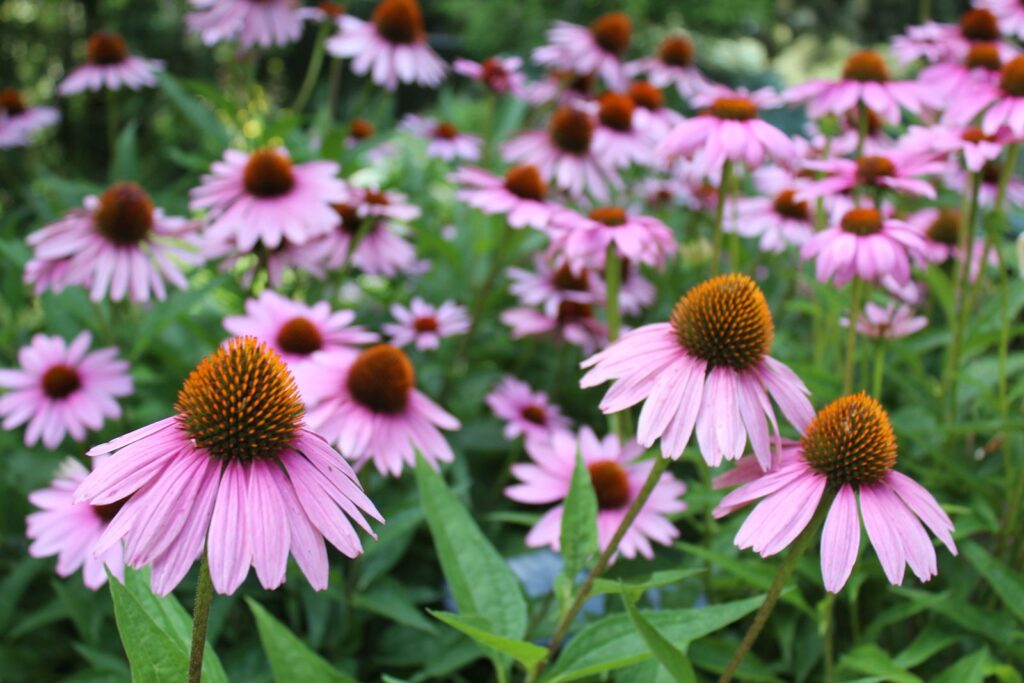
These plants survive the winter and flower every year: daylily, rudbeckia, coneflower (Echinacea), sedums (Sedum), catmint, sage, Russian sage (Perovskia) and ornamental grasses. All of them survive at least zone 5 winters, many even zone 3 (e.g. daylilies, rudbeckias, coneflowers and sedums). Plant in a sunny spot, in soil that is not too rich.
Spacing between plants: for low plants (30–45 cm) 30–38 cm, for medium ones (45–90 cm) 45–60 cm, for tall ones 60–90 cm. In the first year the plants may look sparse; only in the second or third year will they fill the space. They rarely need dividing, about every 3–5 years.
What to cut in autumn and what to leave
- Cut back: peonies and hostas once the leaves yellow or are caught by frost.
- Leave until spring: lavender, Russian sage, coneflowers, sedums, ornamental grasses and evergreen perennials (e.g. pinks and heucheras). The stems protect the plant in winter, and some also decorate the garden.
- Cut ornamental grasses once, in late winter. Russian sage in spring, to about 15 cm.
- Throw away diseased leaves rather than composting them.
- Do not feed perennials in autumn, and keep watering until the ground freezes if there is no rain.
In Lithuanian conditions
Plant after the last spring frosts, from about mid-May, or in autumn at least six weeks before the ground freezes. Mulch new plantings for winter so that frost does not heave the roots. Above all avoid waterlogged spots: in winter wet roots cause the most trouble, especially for lavender.
Common mistakes
- Planting peonies too deep.
- Planting lavender in a wet or shady spot.
- Planting too densely: plants grow, so calculate by the width of the mature plant.
- Piling mulch right onto the crown of the plant.
- Autumn feeding and hard pruning in autumn.
What you will need
- Perennials – plants for the bed
- Ornamental grasses
- Outdoor plants in general
- Care products – products for planting and care
Read also
- Ornamental grasses in a Lithuanian garden: which survive the winter
- Preparing the garden for winter: what to do in autumn
- When to plant shrubs and trees in Lithuania: autumn or spring
- Hosta care: site, watering, slugs and dividing
- Planting peonies and caring for them: when, how and how deep
- Growing lavender in Lithuania: planting, pruning and winter
Not sure what suits your plot? Write to info@graziaplinka.lt or message us on Facebook.