
One of the most common reasons a hydrangea does not flower is shoots pruned at the wrong time. One species sets its flowers on this year’s shoots, another on last year’s, so the rules differ. Here you will find how to tell them apart, and when and how much to prune.
First find out where your hydrangea flowers
Hydrangeas that flower on this year’s shoots form their flower buds in the current season, so pruning does not take them away. Those that flower on last year’s shoots set their buds the previous year, and if you cut off healthy shoots there will be no flowers.
| Species | Flowers on | How to prune |
|---|---|---|
| Panicle hydrangea, Hydrangea paniculata | this year’s shoots | every spring, by a third to a half of the shoot length; old shrubs harder |
| Smooth hydrangea, Hydrangea arborescens | this year’s shoots | every spring, even down to 30–40 cm above the ground |
| Bigleaf hydrangea, Hydrangea macrophylla | last year’s shoots | only dead flower heads and dead shoots |
| Hydrangea serrata (a smaller relative of the bigleaf) | last year’s shoots | very lightly |
| Oakleaf hydrangea, Hydrangea quercifolia | last year’s shoots | hardly at all |
| Climbing hydrangea, Hydrangea petiolaris | last year’s shoots | do not prune, only shorten if too tall |
If you do not know which hydrangea you have, it is better not to prune. Wait until spring, when the buds begin to swell, and remove only the shoots that are definitely dead.
Panicle and smooth hydrangeas: prune boldly
Prune in late March or April, once the hardest frosts have passed but before the shoots burst into leaf. Do not prune in frost.
- Remove dry, broken and diseased shoots.
- Keep a few strong main branches.
- Shorten each branch above a pair of buds so that the last bud faces outwards. Leave 2–3 pairs of buds.
- On a young shrub it is enough to shorten the shoots by a third or a half. For hard rejuvenation the shoots can be cut back to stubs about 15 cm long with two buds.
Smooth hydrangea can be cut back to 30–40 cm above the ground; then there are fewer flower heads, but they are bigger. If the variety has very heavy flower heads, leave the shoots taller so that they do not bend over. Pruning too cautiously is no good either: the shrub is bare inside, the shoots weak and the flower heads smaller. Prune early-flowering panicle varieties such as ‘Early Sensation’ very lightly or not at all.
A standard (tree-form) panicle hydrangea is shaped differently. In the first year keep one straight central shoot, tie it to a stake and remove the side shoots. Then every spring remove the lower shoots from the stem and shorten the crown shoots to about 10 cm.
Bigleaf, Hydrangea serrata and oakleaf: do not overdo it
- Bigleaf. In spring cut the faded flower head back to the first pair of large leaves, and dead or weak shoots right at the base. A dead shoot snaps and has no green tissue inside. Do not remove more than about 30 cm from the branches you keep, and do not prune every year.
- Remontant (reblooming) varieties (they flower on young shoots too): prune carefully, removing only dead flower heads and a few dead shoots. Opinions on harder pruning differ in plant descriptions, so it is safer not to risk it.
- Hydrangea serrata (a smaller relative of the bigleaf). Pruning is very light: only dead flower heads and dead branches.
- Oakleaf. In spring remove frost-damaged and dried shoots, and cut faded flower heads back to new buds. The shape can be corrected right after flowering.
- Climbing. Do not prune regularly; remove only last year’s flowers and shoots that have grown too tall.
How to rejuvenate old shrubs
A neglected bigleaf hydrangea can be rejuvenated over three years: each year cut about a third of the branches back to 30–50 cm, spreading the cuts across the whole shrub. Panicle and smooth hydrangeas can also be rejuvenated with one hard cut close to the ground, but do this no more often than every 4–5 years. Flowering that year may be later and weaker.
Dried flower heads in winter
Do not cut off the faded flower heads in autumn. They protect the buds from frost and look decorative in winter. Cut them off in spring, along with the pruning. In autumn remove only branches that are truly dead or broken. Cutting the shoots of species that flower on old wood in autumn removes the flower buds, and the cut surfaces may be damaged by frost over winter.
In Lithuanian conditions
Foreign advice often says “March”. Here the frosts last longer, and spring frosts still occur until mid-May, so prune panicle and smooth hydrangeas from late March to April, once the snow has melted and the shrub starts to wake up. Do not prune bigleaf hydrangeas early: wait until the buds open and it is clear which shoots have died. Shoots killed over winter are cut back to live wood.
Common mistakes
- Pruning all hydrangeas the same way without knowing the species.
- Pruning bigleaf and oakleaf hydrangeas in autumn or “to the ground after winter”.
- Pruning panicle hydrangeas too cautiously, or not at all.
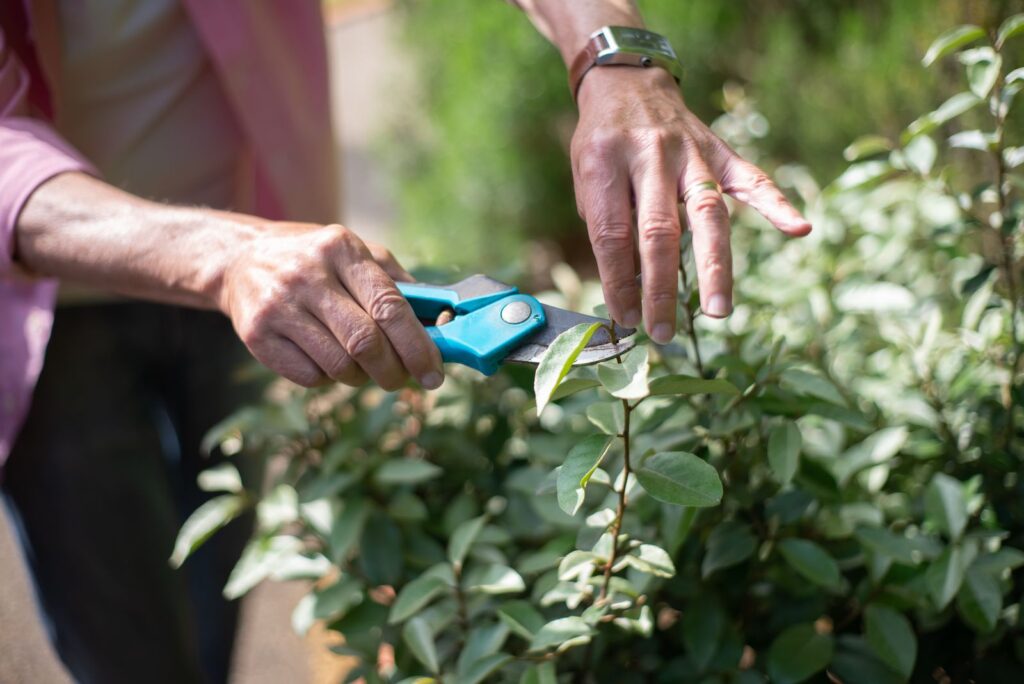
- Cutting with a blunt tool or anvil-type secateurs, which crush the shoot instead of cutting it.
- Pruning one hydrangea all season long to keep it smaller: it grows even bigger.
What you will need
Prune with sharp bypass (not anvil) secateurs, use loppers for branches thicker than a thumb, and wipe the tools with alcohol between shrubs. When pruning for the first time, do not be afraid of mistakes: usually only one season of flowers is lost.
- Hydrangeas – hydrangeas for the garden
- Care products – products for hydrangea care
- Consultations – if you are not sure which hydrangea you have
Read also
- Hydrangea care in Lithuania: which ones survive the winter
- Pruning ornamental shrubs: when and how
- Pruning roses: when and how to prune each type of rose
Email us at info@graziaplinka.lt or message us on Facebook and we will help identify your hydrangea.